
Most fleet electrification plans start with the vehicle. Which van, which range, which lease. The harder question sits at the depot. How much power can the site actually take?
Since 2020, our software has managed more than 1.5 million charging sessions across more than 20,000 chargers. The pattern is consistent. Projects rarely stall because of the vehicles. They stall because the connection cannot carry the load. Here are five things I would want every operator to understand before they commit.
1. Capacity, not vehicles, sets the pace
Every depot has an agreed import capacity with its distribution network operator (DNO). That number, not the number of parking bays, decides how many vehicles you can charge at once.
The arithmetic is unforgiving. Twenty vans on 22kW chargers can ask for 440kW the moment they return. Many depots were sized for lighting, offices and a workshop. When the numbers do not fit, the default answer is a bigger connection: an application, a network study, a quote and a place in the queue. Where reinforcement is needed, the timeline can stretch well beyond the vehicle delivery date.
2. Oversizing is an expensive insurance policy
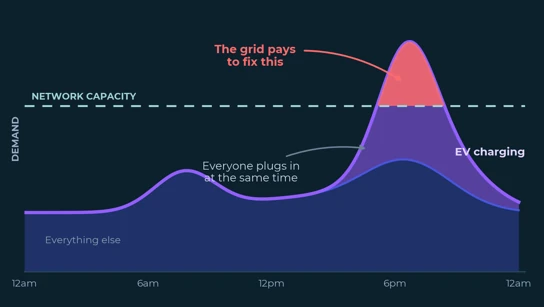
Faced with that uncertainty, many operators request the largest connection they can get. A larger connection means a higher capital contribution and higher capacity charges for the life of the site, whether you use the headroom or not. Breach your agreed capacity and excess capacity charges follow. Charge in the late afternoon and early evening and you pay peak distribution (red band) rates on top. You end up paying for the peak, not the average.
3. Load management fits more chargers on the connection you have
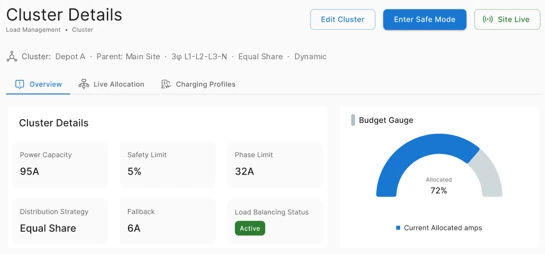
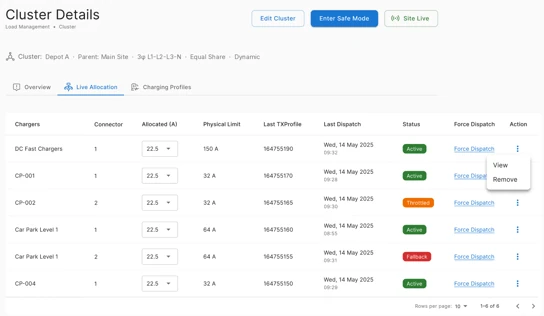
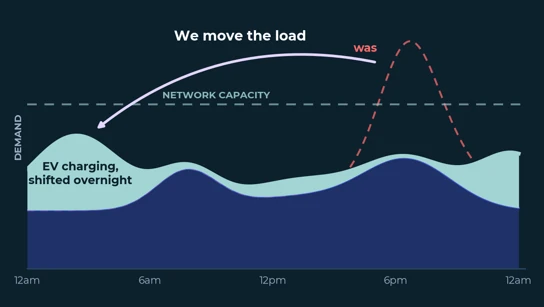
Dynamic load management measures site demand in real time and shares the available power across chargers, so the total never breaches the limit. Vehicles are prioritised by departure time and the charge they need. Most do not need a full battery at full power. They need enough for the next route, delivered before the shift. Spread across a long overnight dwell, that is a far smaller peak, and most of it falls outside the red band.
This is what emPACT, our charge point management platform used by many fleets, does day to day: it balances power across chargers within the site limit and schedules each vehicle to be ready for its shift. The effect can be material. At Ogilvie Fleets, a UK depot running more than 100 vehicles, load management avoided £64k of capital expenditure, saved £40.8k in operating costs and delivered a 415% return on investment over five years.
4. Flexible connections are an opportunity, if you can comply
DNOs increasingly offer flexible, timed or profiled connections: capacity sooner and for less, on condition that the site reduces import when the network is constrained. The catch is compliance. The site must respond automatically, every time, without stranding a vehicle.
That is achievable today. Our SmartFlex platform, for example, receives the DNO’s curtailment signal at flexible-connection sites, holds the site within its limit and protects departure readiness.
5. Your depot’s flexibility is worth money
Once charging is controllable, it has value to the grid. Distribution system operators (DSOs) buy flexibility to manage constrained networks. The National Energy System Operator (NESO) runs the Demand Flexibility Service (DFS) to reduce demand at national peaks. Wholesale trading rewards shifting consumption into cheaper hours.
Each route has its own registration, metering, bidding and settlement, so most operators will work through an aggregator. Electric Miles is live in every UK flexibility market and has delivered more than 40,000 paid grid flexibility events. Whoever you work with, ask three questions: what do you pay upfront, how is revenue shared, and who carries the trading and imbalance risk?
Funding: what the Depot Charging Scheme does and does not cover
The government’s Depot Charging Scheme part-funds charging infrastructure at fleet depots for battery-electric vans, HGVs and coaches. It is a multi-year programme running from April 2026 to 2030. The current window opened on 11 November 2026 and closes at midday on 26 February 2027. It covers 60% of chargepoint and civil costs, up to £1 million per organisation across all its sites, with one application per organisation. Works must be complete by 31 March 2028. Buses are not eligible.
The scheme and the capacity problem are closely linked. It does not pay for grid connection or capacity costs. You must evidence the capacity you have, with a connection agreement, a DNO letter or an accepted connection offer, and show that it covers at least 75% of the planned chargers’ maximum load. Load management helps you get the most from that connection, but it is not a route to applying for more chargers than your supply can support. Size charger numbers and power to your duty cycles and your capacity, not the other way round. Battery storage that supports charging can still be included where it helps with grid constraints.
Before you apply, prepare:
- capacity evidence from your DNO or connection agreement;
- your battery-electric fleet, current and planned, matched to the chargers requested;
- proof you own or lease the depot, and landlord permission if leased;
- installer quotes, your procurement approach and a plan to finish by 31 March 2028;
- senior sign-off and your share of the funding.
Do not order chargers or start civils before the grant funding agreement is signed. The scheme’s pre-assessment questionnaire is a sensible first step.
Getting started, and scaling
Many operators tell us the hardest part is knowing where to begin. That is why I founded Charge My Depot, an initiative led by Electric Miles. It brings fleet operators together with charger manufacturers and installers, and helps depots move from site assessment and design, through a funding application, to installation and day-to-day operation. It is our initiative, not an independent body, and it is not part of the government scheme.
Electric Miles has also secured a government grant-funded project to trial commercial flexibility from EVs. If your depot would like to help shape how fleet flexibility works, we would welcome you in the trial: sales@electricmiles.com.
A practical checklist
- Know your number. Agreed import capacity and a half-hourly demand profile.
- Map duty cycles. Return, departure, mileage and dwell for every vehicle.
- Model managed demand first. Before you request a bigger connection.
- Ask about flexible connections. And what compliance requires.
- Read your tariff. Capacity charges, excess charges and red band timings.
- Specify open standards. OCPP chargers keep your options open.
- Plan for failure. A charge point management system such as emPACT should show which chargers are working and which vehicles still need charge before the morning shift, not during it.
- Check funding early. Capacity evidence takes longest to gather.
Getting the foundations right
None of this is a reason to delay electrification. It is a reason to plan it from the connection outwards. Depots that treat capacity as something to manage, not something to buy, electrify sooner, spend less and turn their charging into a grid asset.
More on depot capacity: what is EV depot charging? and dynamic load management for EV charging.